2026 Estate Tax Sunset and Business Valuation
Executive Summary
The biggest 2026 headline is that the original federal estate-tax “sunset” many advisors spent years planning around is no longer the operative federal rule. The 2017 Tax Cuts and Jobs Act temporarily doubled the estate and gift tax basic exclusion amount for transfers made from 2018 through 2025, and it was originally scheduled to revert after 31 December 2025. But Congress changed that result in 2025. Current federal law, as reflected in amended Internal Revenue Code § 2010(c)(3), sets the basic exclusion amount at $15,000,000 for 2026, with inflation indexing after 2026. The Internal Revenue Service also states that the 2025 basic exclusion amount was $13,990,000. In other words, for federal purposes, 2026 is not a cliff year anymore; it is actually a more taxpayer-favorable exemption year than 2025.
That does not mean business valuation has become less important. It means the reason valuation matters has shifted. Federal estate tax exposure remains critical for taxable estates - meaning the gross estate after deductions and taking prior taxable gifts and available credits into account - that exceed the exemption. But in 2026 the more important valuation questions for many business owners are: whether a lifetime gift still makes sense when a death-time basis adjustment under § 1014 is still available; whether state estate or inheritance tax applies at much lower thresholds; whether a buy-sell agreement will actually control transfer-tax value after the Supreme Court’s 2024 Connelly decision; and whether the appraisal is strong enough to withstand scrutiny under the willing-buyer/willing-seller fair-market-value standard used in estate and gift tax valuation.
For valuation professionals and business owners, the core practical point is this: tax law does not change fair market value, but it changes the consequences of fair market value. A 5% swing in indicated value may be routine in a closely held company appraisal. Under a lower exemption regime, that swing can change tax liability by millions. Under the current 2026 federal regime, the same swing may instead change the answer to a different question: “Should the owner gift now, or retain until death to preserve a step-up in basis?” The valuation assignment therefore has to be integrated with transfer-tax modeling, state death-tax analysis, basis planning, liquidity planning, and succession planning.
This article is written for business owners and advisors preparing for 2026 and beyond. It explains the original Tax Cuts and Jobs Act mechanics, what actually happened in 2025, how 2025 and 2026 compare, how estate tax rules interact with the income, market, and asset approaches to value, and which planning moves still matter in the current law environment. It also highlights the state death-tax regimes that continue to make business valuation strategically important even when a family no longer expects to owe federal estate tax.
What the Tax Cuts and Jobs Act Changed and What Actually Happened in 2026
The 2017 Tax Cuts and Jobs Act did not repeal the estate tax. Instead, it temporarily doubled the estate and gift tax exemption by increasing the basic exclusion amount in § 2010(c)(3) from $5 million to $10 million, indexed for inflation, for decedents dying and gifts made after 31 December 2017 and before 1 January 2026. The Joint Committee on Taxation explained that this temporary increase also increased the generation-skipping transfer tax exemption because the GST exemption is tied to the estate-tax exclusion amount. It also expressly anticipated Treasury regulations to prevent “clawback” if a donor used the larger exclusion during life and died after the exclusion later fell.
Treasury and the IRS responded with final anti-clawback regulations in 2019. Their core rule was that taxpayers who made large completed gifts while the temporary higher exclusion was in effect would not lose the benefit of that exclusion if the exclusion later dropped. The IRS summarized the rule this way: the estate-tax computation effectively uses the greater of the basic exclusion amount applicable to lifetime gifts or the amount applicable at death, for purposes of preventing the prior use of the higher exclusion from being “recaptured.” That guidance was essential under the original sunset framework.
The original sunset was therefore real. The Joint Committee on Taxation’s explanation states plainly that the TCJA increase “does not apply for estates of decedents dying after December 31, 2025,” and the IRS FAQs repeated that the higher exclusion was scheduled to revert in 2026 to its pre-2018 level of $5 million, adjusted for inflation. That was the legal backdrop for the enormous estate-planning focus on “use it or lose it” gifting between 2018 and 2025.
Then Congress changed the law again. Current § 2010, as updated by Public Law 119-21, § 70106, now provides a $15,000,000 basic exclusion amount and removes the old temporary TCJA subparagraph that had limited the doubled amount to the 2018–2025 window. The statutory text now also provides post-2026 inflation indexing using 2025 as the new base year. The IRS’s estate-and-gift-tax “What’s New” page confirms the same point and identifies the 2025 law as the source of the change.
The practical result is that a large amount of pre-July-2025 “2026 sunset” planning commentary is now historically interesting but no longer current as a predictor of federal law. A serious 2026 article must explain both the original sunset mechanics and the fact that the federal cliff was legislatively superseded. Otherwise it risks being technically sophisticated and still materially outdated.
Federal regime comparison
The table below distinguishes among 2025 actual law, 2026 actual current law, and a counterfactual 2026 sunset scenario showing what planners were modeling before the 2025 amendment.
| Item | 2025 actual law | 2026 actual current law | Counterfactual 2026 if the original TCJA sunset had governed |
|---|---|---|---|
| Basic exclusion amount | $13.99M | $15.00M | Reverts to pre-2018 law base of $5M, indexed for inflation |
| GST exemption | Tied to estate/gift exclusion | Tied to estate/gift exclusion | Would have reverted with the estate/gift exclusion |
| Estate/gift DSUE portability | Yes, if properly elected on estate tax return | Yes, unchanged | Yes, unchanged |
| Top marginal federal estate tax rate | 40% | 40% | 40% |
| Step-up in basis at death under § 1014 | Unchanged | Unchanged | Unchanged |
| Anti-clawback relevance | Important for pre-2026 completed gifts | Still relevant for gifts already made before 2026 | Would have been especially important |
Source note: 2025 amount from IRS Rev. Proc. 2024-40; 2026 current law from amended IRC § 2010 and IRS 2026 estate/gift update; original sunset mechanics from the Joint Committee on Taxation and IRS FAQ. The counterfactual column is a legal scenario description, not current law.
Note on GST: GST exemption is tied to the basic exclusion amount, but unused GST exemption is not portable between spouses in the same way as the deceased spousal unused exclusion (DSUE) for estate and gift tax.
Timeline of the federal rules
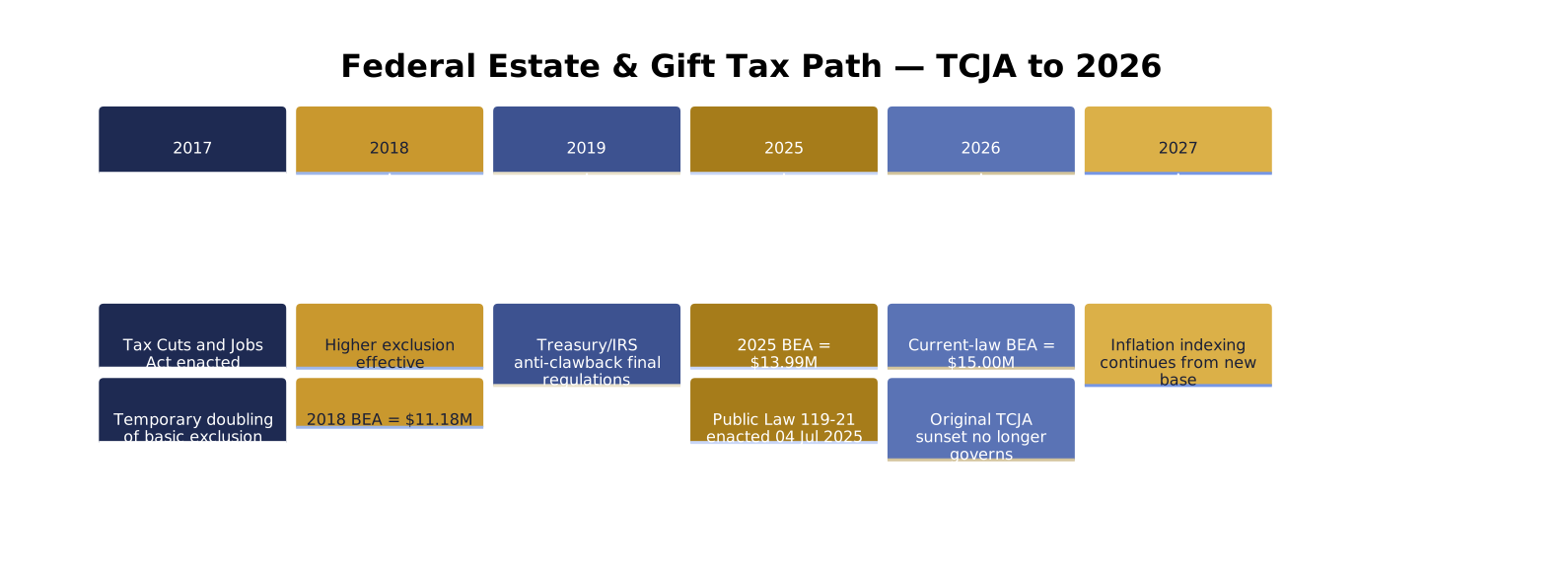
The question for business owners in 2026 is therefore no longer “How do I beat the federal cliff before it disappears?” The more precise question is “Given the larger federal exclusion, my business value, my basis, my state of domicile, and my succession structure, what transfer strategy now produces the best combined transfer-tax and income-tax result?”
How Estate Tax Rules Change Business Valuation
For federal estate and gift tax purposes, valuation still begins with the same foundational standard: fair market value, defined by Treasury regulations as the price at which property would change hands between a willing buyer and a willing seller, with neither under compulsion and both having reasonable knowledge of relevant facts. That definition is neutral as to whether the basic exclusion amount is $13.99 million, $15 million, or something lower. The estate-tax law changes the tax result, not the legal definition of value.
That is why the classic authorities still matter. The IRS continues to treat Revenue Ruling 59-60 as foundational for closely held business valuation in transfer-tax work, and the IRS’s S corporation valuation job aid warns against isolating a single variable, such as pass-through tax status, without considering the broader valuation context. Professional-development standards from the American Institute of Certified Public Accountants and the American Society of Appraisers likewise continue to organize business valuation around the income, market, and asset approaches, with explicit attention to discounts, premiums, data quality, and supportable reasoning.
So where does the 2026 federal rule shift actually hit valuation practice? In four places.
First, it changes the decision-usefulness of the appraisal. Before the 2025 change, many appraisals were commissioned primarily to lock in gifts before the expected exclusion drop. In current 2026 federal law, many of those same owners may be below the federal threshold and therefore will use the valuation more for step-up versus gift analysis, buy-sell updates, and state-tax planning than for pure federal estate-tax minimization.
Second, it changes the marginal tax sensitivity of value conclusions. Under any regime, a closely held business appraisal can move because of revised cash-flow forecasts, a one-turn difference in EBITDA multiple, a different discount rate, a minority-interest adjustment, or a marketability discount. But if the owner’s taxable estate (after deductions and taking prior taxable gifts and available credits into account) sits near an applicable threshold, each dollar of value above the threshold can carry a large marginal transfer-tax cost. Under current federal law that threshold is higher than previously feared, but in many state-tax jurisdictions the threshold is still low enough that valuation sensitivity remains very large.
Third, the current law makes basis planning more important for many mid-market owners. Under § 1014, property acquired from a decedent generally receives a basis equal to fair market value at death. By contrast, lifetime gifts generally take a carryover basis. When the federal estate-tax cost of holding until death falls, the relative value of preserving the death-time basis adjustment rises. This is one of the single most important reasons that business owners should not reflexively apply pre-2025 “gift everything before 2026” advice to current 2026 planning.
Fourth, estate valuation now interacts even more visibly with succession-document design. The Connelly decision makes clear that life-insurance proceeds owned by a corporation can increase transfer-tax value without the corporation’s redemption obligation necessarily offsetting that increase. That is not a change to valuation theory so much as a reminder that valuation, entity design, and buy-sell drafting cannot be siloed.
Practical valuation decision framework

The valuation analyst’s job, therefore, is not only to estimate value but to show how the value behaves under different legal and tax facts. That means sensitivity tables, defensible support for discounts, clear explanation of basis consequences, and explicit statement of whether the assignment is for a controlling or noncontrolling interest and whether the value assumes a sale, continued operation, or underlying-asset realization.
Quantitative Valuation Examples and Sensitivity Analyses
The examples below are simplified and intentionally transparent. They ignore deductions, prior taxable gifts, marital deduction planning, charitable transfers, GST complications, and state taxes unless noted. They are designed to show how valuation conclusions interact with the 2025 and 2026 federal regimes.
Income approach example
Assume a closely held operating company is being valued on a debt-free basis using a simple capitalization of next-year cash flow. Next-year distributable cash flow is $2.0 million. Long-term growth is 3%. The capitalization rate is the difference between the equity discount rate and growth.
Base case formula:
Equity Value = Cash Flow ÷ (r − g)
If r = 15% and g = 3%, the indicated equity value is:
$2,000,000 ÷ (0.15 − 0.03) = $16.67 million
That is a normal valuation exercise under the income approach. The 2026 law affects what happens after you believe the answer, not how the math is done. The income approach itself remains grounded in the same fair-market-value framework used for estate and gift tax valuation.
Sensitivity table
| Scenario | Discount rate | Growth rate | Indicated value | Approx. federal estate tax in 2025 | Approx. federal estate tax in 2026 current law | Illustrative tax under a hypothetical $7.0M sunset scenario |
|---|---|---|---|---|---|---|
| A | 14% | 3% | $18.18M | $1.68M | $1.27M | $4.47M |
| B | 15% | 3% | $16.67M | $1.07M | $0.67M | $3.87M |
| C | 16% | 3% | $15.38M | $0.56M | $0.15M | $3.35M |
| D | 15% | 2% | $15.38M | $0.56M | $0.15M | $3.35M |
| E | 15% | 4% | $18.18M | $1.68M | $1.27M | $4.47M |
Assumptions: Federal tax approximated at 40% of value above the applicable exclusion amount; no prior taxable gifts; no deductions; no marital or charitable transfers. The 2025 exclusion is $13.99M, the 2026 current-law exclusion is $15.0M, and the rightmost column is an illustrative hypothetical for the now-superseded sunset planning model.
The sensitivity result is the important insight. A one-point change in the discount rate from 15% to 16% reduces indicated value by roughly $1.29 million in this simple model. Near a tax threshold, that is not merely a technical valuation dispute. It can be the difference between a relatively small transfer-tax exposure and a very large one. Under the current 2026 federal regime, the damage from that swing is smaller than planners once feared. But the swing is still material for federal taxable estates above $15 million and can be even more material in lower-threshold state regimes.
Market approach example
Now assume the same business has normalized EBITDA of $3.2 million and comparable-company/transaction evidence supports a valuation range of 5.5x to 6.5x EBITDA. Debt is $2.0 million. We are valuing a 30% noncontrolling interest, and after facts-and-circumstances analysis the appraiser applies a 10% discount for lack of control and a 20% discount for lack of marketability.
| Multiple | Enterprise value | Equity value after debt | 30% pro rata | After 10% DLOC | After 20% DLOM | Indicated noncontrolling interest value |
|---|---|---|---|---|---|---|
| 5.5x | $17.60M | $15.60M | $4.68M | $4.21M | $3.37M | $3.37M |
| 6.0x | $19.20M | $17.20M | $5.16M | $4.64M | $3.72M | $3.72M |
| 6.5x | $20.80M | $18.80M | $5.64M | $5.08M | $4.06M | $4.06M |
This is why estate and gift tax valuation fights often center on “small” assumptions. A half-turn movement in the EBITDA multiple changes the noncontrolling interest indication by roughly $345,000 in this example, and a full turn changes it by roughly $691,000. If the interest is part of a larger estate that sits near a federal or state threshold, that is enough to change the threshold outcome. IRS guidance and professional standards therefore emphasize that appraisers must explain comparables, normalization adjustments, and discounts carefully rather than rely on unsupported conventions.
The existence of discounts is well documented in valuation literature, but the literature does not justify mechanical use of a generic number. The Journal of Business Valuation and Economic Loss Analysis is a refereed journal, and one cited private-company-discount study by Paglia and Harjoto found very large average discounts in a matched private/public multiples analysis. Even so, courts and the IRS still expect case-specific support. A study can inform judgment; it does not replace appraisal reasoning under Revenue Ruling 59-60 and the willing-buyer/willing-seller standard.
Asset approach and basis-planning example
Assume a founder owns a business worth $10 million with a tax basis of $1 million, and the founder has $8 million of other assets. Ignore state tax for the moment.
If the founder gifts the business in 2026: the business is removed from the later gross estate, but the donees generally take the founder’s carryover basis. In economic terms, the family has moved $10 million of value out of the estate while also preserving $9 million of built-in gain in the hands of the recipients.
If the founder retains the business until death in 2026: the gross estate is $18 million, which is about $3 million above the current-law federal exclusion. Using the same rough 40% marginal approach, the federal transfer-tax cost on that excess is about $1.2 million. But the heirs generally receive a basis equal to fair market value at death under § 1014, which means the $9 million of embedded appreciation is generally stepped up out of built-in gain.
That comparison is the heart of 2026 planning under current federal law. For a family once worried about a severe 2026 exemption drop, gifting the business before death may have looked obviously correct. Under current law, the answer is no longer obvious. If the owner is near or only moderately above the federal threshold, the income-tax value of the § 1014 basis adjustment may outweigh some or all of the transfer-tax savings from gifting. The appraisal therefore has to be paired with a basis model, not only an estate-tax model.
A further practical wrinkle is basis consistency. Treasury’s final regulations under § 1014(f) explain that certain inherited property subject to the consistent-basis requirement must take an initial basis no greater than its final federal estate tax value. That does not change the availability of § 1014 itself, but it does underscore why the estate-side valuation record needs to be defensible if the family later disposes of the business or its assets.
Buy-sell agreements and Connelly
The 2024 Connelly case is now mandatory reading for closely held business owners who use company-owned life insurance to fund redemptions. The Supreme Court held that a corporation’s contractual obligation to redeem a decedent’s shares at fair market value did not necessarily reduce the corporation’s value for federal estate-tax purposes. In the case itself, the Court described the IRS value as $6.86 million rather than $3.86 million because the corporation’s $3 million of life-insurance proceeds counted as a corporate asset, and the resulting increase in share value produced $889,914 of additional tax.
That does not mean entity redemption agreements are unusable. It means they must be re-underwritten with valuation counsel, tax counsel, and estate counsel together. If the company owns the policy, the company’s balance sheet, the valuation method, the agreement formula, and the estate-tax consequences can no longer be treated as separate silos. Connelly also amplifies the importance of § 2703, which tells us that certain restrictions and price-setting rights are disregarded for transfer-tax valuation unless the statutory exception is met.
Planning Strategies for Business Owners
The first strategic move for 2026 is not a trust or a restructuring. It is a fresh integrated model. Owners who planned aggressively for a 2026 sunset should revisit their estate, gift, GST, basis, domicile, and liquidity assumptions using current federal law rather than planning memos written before 4 July 2025. A qualified business appraisal remains the starting point because the value conclusion drives almost every downstream decision.
For owners who are well below the current federal exclusion and who do not live in a state with a meaningful death tax, the 2026 federal law change often strengthens the case for retaining highly appreciated business interests until death if the family expects a later sale. The reason is simple: a lifetime gift generally shifts appreciation out of the estate but also preserves carryover basis, while death generally preserves the § 1014 fair-market-value basis adjustment. This is especially important for businesses with low tax basis, appreciated real estate, or goodwill that would otherwise generate substantial gain on sale.
For owners whose taxable estate (after deductions, prior taxable gifts, and available credits) is meaningfully above the federal exclusion, lifetime transfers still matter. The current law is more favorable than the old sunset model, but $15 million per person is not unlimited, and the exclusion remains unified across life and death. Completed gifts can still remove future appreciation from the transfer-tax base. The historic anti-clawback regulations remain important context for large gifts that were already made during the temporary-exemption years and for any future planning in case Congress changes the law again.
Trust planning therefore remains highly relevant, but the rationale varies. Spousal lifetime access trusts, GRATs, sales to grantor trusts, and preferred-equity or recapitalization freezes are still common techniques in sophisticated transfer planning. In 2026, however, these structures should be analyzed less as “panic before the cliff” tools and more as appreciation-shift, control, creditor-protection, and family-governance tools. The tax benefit from moving a fast-growing business may still be very strong. The tax benefit from moving a stable, highly appreciated business may be partially offset by the loss of basis step-up. The appraisal must therefore differentiate between present value, expected appreciation, and embedded gain.
Buy-sell agreements deserve immediate review. Section 2703 is still the central federal rule for whether an option, agreement, or restriction will be respected in transfer-tax valuation. After Connelly, closely held businesses using entity redemption structures and corporate-owned life insurance should examine whether a cross-purchase design, an insurance LLC, or revised pricing mechanics better align legal documents with intended value and liquidity outcomes. The key point is not that one structure is universally better; it is that the old “insurance solves the liquidity problem” intuition can be wrong if the valuation consequence is ignored.
Liquidity planning remains indispensable for illiquid estates. Section 6166 may allow installment payment of estate tax when the value of a closely held business interest included in the gross estate exceeds 35% of the adjusted gross estate, subject to the statute’s other requirements. Section 303 can allow stock redemptions to fund death taxes and administration expenses with more favorable income-tax treatment than a dividend. Section 2032A can reduce value for qualifying farm or business real property by allowing special-use valuation, subject to statutory limits. These provisions do not replace good valuation work; they are relief valves that depend on it.
Entity selection also matters. The IRS’s S corporation valuation job aid expressly warns against isolating pass-through tax status as a single variable. In practice, entity form affects expected cash taxes, capital structure, owner distributions, discount rates, and the relevance of built-in gain. A C corporation with appreciated operating assets, for example, can present very different valuation and exit consequences from an S corporation or LLC taxed as a partnership. That means “entity selection” for estate-planning purposes is not just a legal-box exercise; it is a valuation-input exercise.
The main legal and tax risks in this area are predictable. They include outdated appraisals, unsupported discounts, unreviewed buy-sell agreements, inadvertent loss of portability through failure to file a proper return, overuse of gifting without modeling the basis cost, and state-level surprises where a taxpayer is under the federal exemption but still above a state threshold. The rising importance of basis consistency and the continued IRS reliance on fact-intensive fair-market-value valuation mean that business owners should assume that documentation quality matters as much as planning creativity.
State-Level Estate and Inheritance Tax Interactions
Even with the federal exclusion at $15 million in 2026, state death taxes still keep valuation highly relevant. Secondary compilations maintained by the American College of Trust and Estate Counsel and the Tax Foundation show that, as of 2026, the jurisdictions with a separate estate tax include Connecticut, the District of Columbia, Hawaii, Illinois, Maine, Maryland, Massachusetts, Minnesota, New York, Oregon, Rhode Island, Vermont, and Washington. The jurisdictions with an inheritance tax include Kentucky, Maryland, Nebraska, New Jersey, and Pennsylvania. These state regimes often apply at thresholds dramatically below the federal level.
A full 50-state technical chart would be too long to reproduce here, and several state thresholds change annually or have recently changed. For planning purposes, the most important point is that a business owner can be completely outside federal estate-tax exposure and still need a rigorous valuation because of state law. That is especially true where the state tax has a low threshold, a gift add-back rule, no portability, a separate state QTIP regime, unusual rate structure, or inheritance-tax classes tied to family relationship.
Key 2026 state traps and valuation consequences
| Jurisdiction | Type | High-value point for business owners |
|---|---|---|
| New York | Estate tax | 2026 basic exclusion amount is $7.35M. The state requires add-back of certain taxable gifts made within three years of death, and the credit phases out as the taxable estate approaches 105% of the exclusion amount, creating the well-known “cliff.” |
| Massachusetts | Estate tax | Official guidance states that for decedents dying in 2023 and after, the applicable exclusion amount is $2.0M, and future federal estate-tax changes do not affect that threshold. That makes valuation planning relevant for many businesses that are nowhere near the federal level. |
| Maryland | Estate and inheritance tax | Maryland’s estate-tax exclusion remains $5.0M for decedents dying in 2019 and later, and Maryland established portability at the state level. Official guidance also confirms that inheritance-tax payments interact with the Maryland estate tax. This dual-tax environment makes entity and liquidity planning especially important. |
| District of Columbia | Estate tax | The District’s Office of Tax and Revenue states that the 2026 exclusion amount is $4,988,400. Business owners often miss it because the federal threshold is so much higher. |
| Washington | Estate tax | For deaths from 1 January 2026 through 30 June 2026, the filing threshold and exclusion amount are $3,076,000. For deaths on or after 1 July 2026, SB 6347 resets the applicable exclusion amount to $3,000,000 and rolls back the higher 2025 rate schedule. Business valuations remain important because Washington requires filing based on gross estate value and has specific expectations for closely held or non-public business interests. |
| Connecticut | Estate tax and separate gift tax | Connecticut remains unusual because it has both an estate tax and a standalone gift tax. Current DRS materials show a $13.99M 2025 estate/gift threshold and a $15M cap on aggregate Connecticut gift and estate tax, but practitioners should confirm the current 2026 DRS release before filing. |
| New Jersey | Inheritance tax | New Jersey no longer imposes a stand-alone estate tax, but it still imposes an inheritance tax. Official materials distinguish Class A beneficiaries, for whom no tax is due, from other beneficiary classes that face graduated rates. That makes who receives the business interest a core planning variable. |
| Pennsylvania | Inheritance tax | Pennsylvania’s official rates are relationship-based: 0% for a surviving spouse or a parent from a child aged 21 or younger, 4.5% for direct descendants, 12% for siblings, and 15% for other heirs. That structure can influence whether voting and nonvoting interests are transferred during life or at death. |
| Kentucky | Inheritance tax | Kentucky’s Department of Revenue classifies beneficiaries by relationship and states that Class B and Class C beneficiaries face exemptions and graduated rates. Again, the valuation issue is not just what the business is worth, but which family member or nonfamily member receives it. |
| Nebraska | County inheritance tax | Nebraska imposes a county inheritance tax and computes tax on the fair market value of inherited interests. The county-based structure means local probate and compliance mechanics matter alongside valuation. |
The federal 2026 law therefore reduces but does not eliminate the need for transfer-tax valuation work. In states like Massachusetts, Washington, New York, the District of Columbia, and Maryland, valuation still directly drives filing, audit, and liquidity outcomes for many owners who will never owe federal estate tax.
Limits and verification note
State death-tax rules are more volatile than many business owners realize. Thresholds are adjusted, forms are revised, and not every state conforms to federal valuation or basis assumptions in the same way. This article focuses on high-confidence 2026 points drawn from official pages where available and respected 50-state summaries where necessary. Before filing or restructuring, owners should confirm current forms, thresholds, and any 2026 legislative changes directly with the relevant state tax authority.
Frequently Asked Questions
What happened to the 2026 estate tax sunset? The original TCJA sunset was real, but it is no longer the operative federal rule. Public Law 119-21 amended § 2010 so that the basic exclusion amount is $15,000,000 for 2026, with inflation adjustments after 2026.
What was the federal exclusion amount in 2025? The IRS states that the 2025 basic exclusion amount was $13,990,000.
Did the 2017 Tax Cuts and Jobs Act repeal the estate tax? No. It temporarily doubled the exclusion amount; it did not repeal the estate tax itself.
Is the federal estate tax rate higher in 2026 than in 2025? No. The federal estate and gift tax rate structure still uses the common rate table with a top marginal rate of 40%. The principal TCJA issue was the exclusion amount, not a new higher rate in 2026.
Does portability still exist in 2026? Yes. Current § 2010 still includes portability through the deceased spousal unused exclusion amount, subject to a proper estate tax return and election.
Did the 2025 law change step-up in basis at death? No. Section 1014 still generally provides a fair-market-value basis at death for property acquired from a decedent, subject to the statute’s limitations and the consistent-basis rules where applicable.
Why can gifting be worse than holding until death under current law? Because a lifetime gift usually carries over the donor’s basis, while death generally triggers a basis adjustment under § 1014. When the estate-tax cost of death is lower, the value of that basis adjustment can become more important.
Does 2026 federal law make business valuations less important? No. It changes the planning question. Valuations are still central to federal taxable-estate modeling, state death-tax exposure, gifting decisions, buy-sell design, basis consistency, and succession planning.
What valuation standard applies for estate and gift tax? Fair market value under the willing-buyer/willing-seller test. Treasury regulations make clear that forced-sale value is not the right measure.
What authority still anchors closely held business valuation for transfer-tax work? Revenue Ruling 59-60 remains foundational, and the IRS’s own valuation materials continue to direct appraisers back to it.
Do minority and marketability discounts still matter after the federal exclusion increased? Yes. They still matter whenever a noncontrolling interest is being valued, especially for gifts, split-family ownership, audit defense, and state death-tax planning. The size of any discount must still be fact-specific and well supported.
What did Connelly v. United States change? It confirmed that corporate-owned life-insurance proceeds can increase value for federal estate-tax purposes, and the corporation’s redemption obligation does not necessarily offset that increase.
Can a buy-sell agreement fix estate tax value by itself? Not necessarily. Section 2703 says certain options, agreements, or restrictions are disregarded unless they satisfy the statutory exception.
What if the estate is business-rich but cash-poor? Section 6166 may allow installment payment of estate tax when the value of a closely held business interest included in the gross estate exceeds 35% of the adjusted gross estate, and Section 303 may allow redemptions to fund death taxes and expenses on more favorable terms.
Do state taxes still matter if I am below the federal $15 million threshold? Absolutely. States such as Massachusetts, Washington, New York, the District of Columbia, and Maryland have much lower state thresholds or separate inheritance-tax systems.
Which states should business owners watch most carefully? For many owners, the highest-impact state traps are Massachusetts’s $2M threshold, Washington’s low threshold and closely held business filing expectations, New York’s exclusion cliff and gift add-back, Maryland’s estate-and-inheritance interaction, and beneficiary-based inheritance-tax regimes in Pennsylvania, New Jersey, Kentucky, and Nebraska.
Should business owners still make large gifts in 2026? Sometimes yes, but not automatically. Owners above the federal or state thresholds, or owners of rapidly appreciating companies, still have strong reasons to gift. Owners below the threshold with highly appreciated low-basis businesses may find that preserving § 1014 step-up is more valuable.
What is the most common planning mistake in 2026? Using pre-July-2025 sunset advice without re-running the numbers under current law. In 2026, the correct planning comparison is no longer “gift before the cliff or lose the exemption”; it is “gift versus retain, after modeling transfer tax, basis, state death tax, and liquidity.”
Sources
Primary federal sources
- Joint Committee on Taxation, General Explanation of Public Law 115-97 (TCJA), Part VI on the increase in estate and gift tax exemption
- Internal Revenue Code § 2010, current text
- IRS, “What’s new - Estate and gift tax”
- IRS Rev. Proc. 2024-40, 2025 inflation adjustments
- IRS, “Estate and Gift Tax FAQs”
- Treasury Regulation § 20.2031-1, fair market value standard
- Internal Revenue Code § 1014 and Treasury Regulation § 1.1014-1
- Treasury Regulation § 1.1014-10, consistent basis requirement
- Internal Revenue Code §§ 303, 2032A, 2703, and 6166
- Treasury Regulation § 20.6166A-1
- Connelly v. United States, Supreme Court opinion (2024)
- Public Law 119-21 (2025)
Primary state sources
- New York Department of Taxation and Finance - estate tax pages and reform memo on the 105% phaseout
- Massachusetts Department of Revenue - filing threshold guidance
- Washington Department of Revenue - estate tax pages and FAQ; Washington SB 6347 (2025 session law amending the applicable exclusion amount and rate schedule effective 1 July 2026)
- District of Columbia Office of Tax and Revenue - 2026 tax-change notice
- Maryland Comptroller - estate and inheritance tax filing guidance and FAQ
- New Jersey Division of Taxation - inheritance tax overview and rates
- Pennsylvania Department of Revenue - inheritance tax pages and current tax rates
- Kentucky Department of Revenue - inheritance tax page
- Nebraska Department of Revenue - inheritance tax page and Chapter 17 regulations
- Connecticut Department of Revenue Services - estate and gift tax information
Professional standards and valuation literature
- AICPA, Statement on Standards for Valuation Services, VS Section 100
- AICPA, Business Valuations for Estate and Gift Tax Purposes – Practice Aid
- ASA Business Valuation Standards
- IRS S Corporation Valuation Job Aid
- Journal of Business Valuation and Economic Loss Analysis
- Paglia, J. K., & Harjoto, M. A. (2010), “The Discount for Lack of Marketability in Privately Owned Companies: A Multiples Approach”
Selected secondary references
- ACTEC State Death Tax Chart
- Tax Foundation, Estate and Inheritance Taxes by State